
Why it matters · The AI era
AI answers your customers before Google does. Wikipedia is what it reads.
800 million people ask ChatGPT every week, and 2 billion see Google's AI answers every month — and those models don't read your website. They read Wikipedia, Wikidata and Reddit. We build and defend the verified sources that decide what AI says about you.
15 years · 4,000+ Wikipedia & Wikidata projects · 93% survive Wikipedia's review · 160+ languages
The free audit shows what ChatGPT, Claude, Gemini & Perplexity say about you today — and a plan to fix the gaps. No obligation, no sales pitch.
Be the source every engine quotes
- 3.4×
- How many times GPT-3 was trained on Wikipedia — vs 0.44× for the entire open web.
- #1
- Most-cited source in ChatGPT answers: Wikipedia.
- 1%
- Of users click a link inside a Google AI answer. The answer is the destination now.
- ~$60M
- What Google reportedly pays Reddit each year to train AI on its conversations.
GPT-3 paper, OpenAI 2020
Ahrefs, 78.6M queries, 2025
Pew Research, 2025
CBS News / Reuters, 2024
Proof, not theory
What buyers and AI systems actually see
Wikipedia is not just a page. It becomes the source layer behind search entity cards, AI summaries and due-diligence checks. Here is one public figure across three real, public surfaces — each reading from the same Wikipedia and Wikidata record.
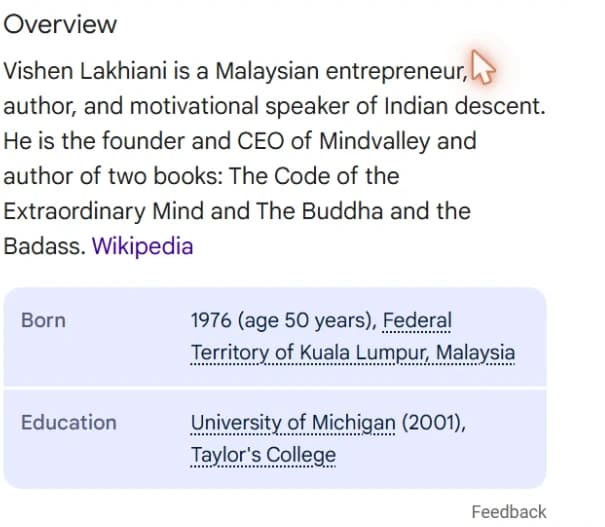 Source: Wikipedia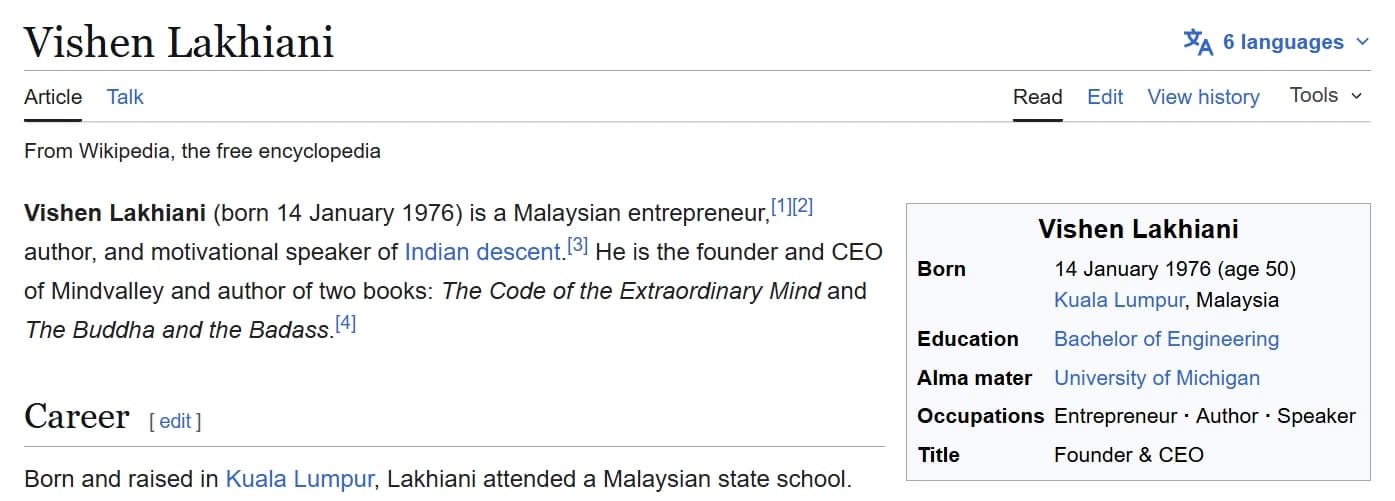
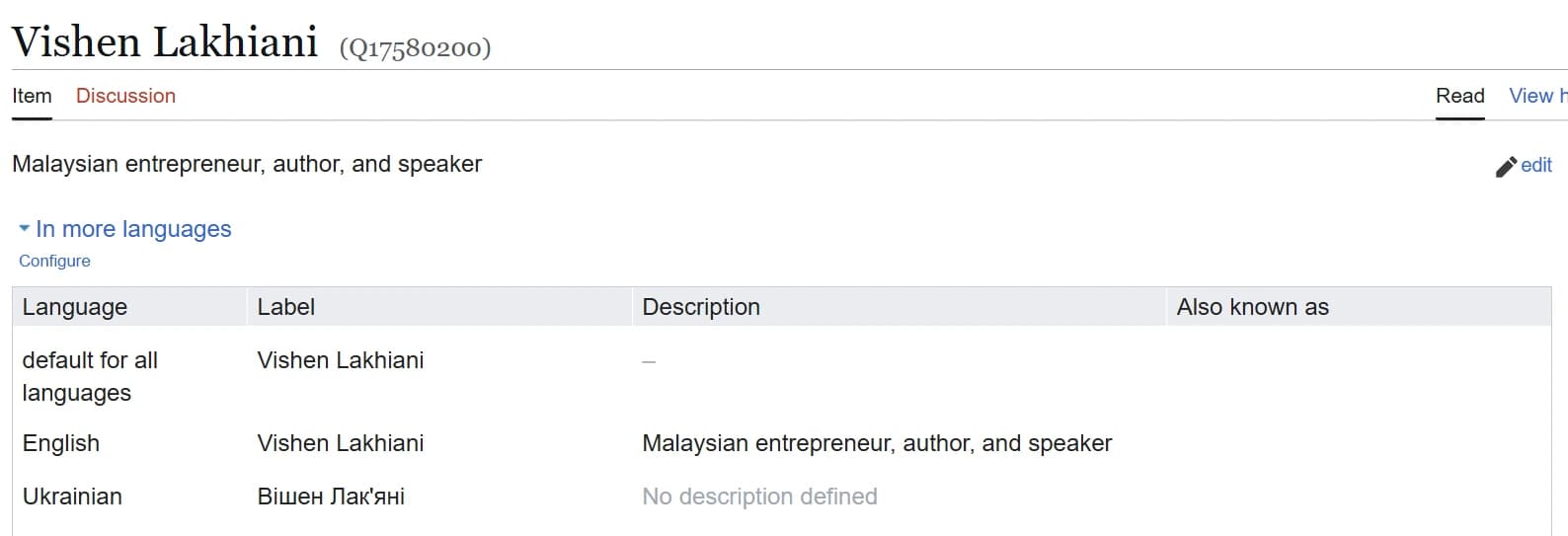 Machine-readable
Screenshots are public examples captured for illustration. Search and AI interfaces change frequently; outcomes are not guaranteed.
Selected work
Pages we've built — and defended
15 years. 4,000+ companies, founders and agencies. 160+ Wikipedia language editions. A few entries you can verify right now:
Trusted by founders & CEOs, CMOs and communications teams, and PR / SEO agencies (white-label).
- 15 yrs
- Building and defending Wikipedia presence since 2010.
- 4,000+
- Companies, founders and agencies served.
- 93%
- Of our pages survive Wikipedia's deletion review.
- 1,000+
- Pages created and edited every year.
The shift
Search didn't die. It moved inside the answer.
For 20 years the game was ranking on Google's first page and earning the click. Generative AI changed the destination: people now read the answer and stop. Ranking #1 matters less than being the source the answer is built from.
15% → 8%
Clicks to any website when a Google AI summary appears
Pew Research, 2025
1%
Of users click a link inside the AI answer itself
Pew Research, 2025
~60%
Of Google searches now end with zero clicks
Bain & Company, 2025
Gartner predicts a 25% drop in traditional search volume by 2026 as people shift to AI assistants. Whether the exact figure holds or not, the direction is unmistakable — and it rewards brands that own the sources AI trusts, not just the keywords Google ranks.
How it works
How AI decides what to say about you
An AI answer about your company isn't pulled from your website. It's assembled from the sources the model trusts. Here's the path your brand has to travel to land in that answer — accurately.
Your brand
- Company / founder
Sources AI trusts
- Wikipedia
- Wikidata
- Reddit · Quora
- Tier-1 media
AI answer engines
- ChatGPT · Claude
- Gemini · Perplexity
- AI Overviews
What your buyer sees
- An accurate,
- cited answer
- about you
Not in the sources? The model has nothing reliable to read — so it paraphrases, uses outdated facts, hallucinates, or names a competitor instead.
Three layers, one truth
AI reads you in three places — Wikipedia sits in all of them
The training layer
Every model with a published training recipe oversamples Wikipedia. GPT-3 weighted it 3% of the mix yet showed it 3.4× — more than any other source — while showing the entire open web less than once. Meta's LLaMA: 4.5%. Frontier models keep their recipes secret, but the pattern is consistent.
The retrieval layer
When ChatGPT, Perplexity, Gemini or Google AI Overviews look something up live, they reach for the same high-trust set first: Wikipedia, Wikidata, Reddit, Quora and tier-1 media. These are the domains AI cites most.
The entity layer
Behind every confident answer is an entity — usually a Wikidata Q-ID. With one, AI treats you as a known company with verified facts. Without one, you're a string of letters it has to guess about.
What's at stake
Right now, AI is answering questions about you. Is it getting them right?
The difference between a confident, cited answer and a shrug — or worse, a competitor's name — comes down to whether AI has trusted sources to read about you.
“I don't have reliable information about Acme Robotics. It may be a smaller company — you might want to check their official website directly.”
“Acme Robotics is an autonomous-warehouse robotics company founded in 2018, headquartered in Austin, Texas. It raised a Series B in 2024 and is led by CEO Jordan Lee.”
How it shows up
What AI returns when your entity is documented
Ask an AI assistant about a company with a clean Wikipedia + Wikidata footprint and you get a confident, structured, cited answer. The source layer decides whether the answer is accurate — or invented.
What is Northwind Robotics? Give a short factual summary with sources.
Northwind Robotics is a warehouse-automation company founded in 2017, headquartered in Tallinn, Estonia. It builds autonomous mobile robots for logistics and was named a 2024 industry “company to watch.” The founder and CEO is Liis Saar.
Sources
The facts line up
Founding year, headquarters, leadership and category all trace back to a Wikipedia article and a Wikidata entity — sources the model trusts.
Without them, AI guesses
No trusted record and the same question returns a shrug, a stale fact, or a competitor’s name — with nothing to correct it.
Illustrative example built to show typical AI behaviour with a documented entity — company shown is fictional; not a live screenshot and not a guaranteed result.
The evidence
Wikipedia is the source AI trusts most — by design
This isn't a marketing claim. It shows up in the models' own training recipes and in every large study of what AI cites.
Training data
Wikipedia is the most-oversampled source in GPT-3
Live citations
Most-cited domains in ChatGPT (illustrative)
Coverage
Each engine reads a different mix. We cover all of them.
No single source wins every AI engine — Wikipedia leads ChatGPT, Reddit leads Perplexity and AI Overviews, Wikidata powers the Knowledge Graph. A coordinated presence is what makes you visible everywhere your buyers ask.
| Source AI reads | ChatGPT | Perplexity | Gemini | AI Overviews | WikiBusines |
|---|---|---|---|---|---|
| Wikipedia | |||||
| Quora | |||||
| Wikidata / Knowledge Graph | |||||
| Tier-1 media |
Wikidata · Knowledge Graph
Wikidata is the machine-readable you
Wikipedia is the story; Wikidata is the structured facts. Together with Wikimedia Commons they feed Google's Knowledge Graph — the engine behind the Knowledge Panel, voice assistants and the facts LLMs return about you.
The pipeline
Google Knowledge Graph
8B+ facts about people, places & companies
A clean Wikidata entity — with the right identifiers, dates and relationships — raises the floor on how accurately AI describes you. Often it moves the needle more than the Wikipedia article itself. See how Wikidata work runs →
What it builds on Google
Acme Robotics
Technology company
Acme Robotics is a robotics company that designs autonomous warehouse systems. It was founded in 2018 and is headquartered in Austin, Texas. from Wikipedia
- Founded
- 2018 · Austin, TX Wikidata
- CEO
- Jordan Lee Wikidata
- Industry
- Industrial robotics
We don't guarantee a Knowledge Panel — Google's systems make that call. Our job is to build the verified entity foundation that materially raises the probability, then track it.
Reddit · Quora
Where AI goes for the 'real' opinion
Encyclopedias give AI the facts; communities give it the verdict. Reddit and Quora are now among the most-cited sources in AI answers — and Google is paying for the privilege.
~$60M/yr
Reported value of Google's deal to license Reddit content for training and search.
CBS News / Reuters, 2024
85th → 7th
Reddit's climb among the most-visible domains in Google search in under a year.
Sistrix via Amsive, 2024
#1
Most-cited domain in Google AI Overviews and Perplexity: Reddit.
Profound, 680M citations, 2025
When people want an honest take, they add “reddit” to the search. AI does the same. Compliant, non-promotional presence in the right communities is now part of how a brand stays accurately represented in AI answers. Explore Reddit AI visibility →
Authority & reach
The most authoritative domain on the open web
Wikipedia averages 508 million views a day across 66 million articles and 342 languages. Its authority is why both Google and AI lean on it — and why a page in each market compounds your credibility globally.
Domain authority by Wikipedia edition
| Language | Domain | Domain Rating | Est. traffic |
|---|---|---|---|
| English | en.wikipedia.org | 96 | ~4.4B / mo |
| German | de.wikipedia.org | 93 | ~320M / mo |
| French | fr.wikipedia.org | 93 | ~280M / mo |
| Spanish | es.wikipedia.org | 92 | ~500M / mo |
| Portuguese | pt.wikipedia.org | 91 | ~165M / mo |
| Chinese | zh.wikipedia.org | 90 | ~140M / mo |
| Arabic | ar.wikipedia.org | 90 | ~95M / mo |
| Ukrainian | uk.wikipedia.org | 85 | ~40M / mo |
- DR 96
- Ahrefs Domain Rating of en.wikipedia.org
- 508M
- Average Wikipedia views per day
- 160+
- Language editions we publish and maintain in
Ahrefs, 2026
Pew Research, 2026
WikiBusines
The difference
With a trusted source layer — and without it
Same company, same questions. The only variable is whether a Wikipedia and Wikidata record exists.
“I don’t have reliable information about this company.”
- No Knowledge Panel on Google
- Thin results — your own site, then random directories
- AI answers are vague, outdated, or skip you for a competitor
“Company X is a [category] firm founded in [year], headquartered in [city], known for …”
- Knowledge Panel with logo, founder and facts
- Wikipedia snippet plus tier-1 media in the results
- AI answers are confident, accurate and cite your sources
Illustrative model — based on common AI / search behaviour, not a guaranteed result.
The business case
What a properly built Wikipedia presence does for you
One asset, working across search, AI answers, the press and the boardroom.
Become the source AI quotes
Be the verified reference ChatGPT, Claude, Gemini and Perplexity read from — instead of being paraphrased, outdated, or skipped for a competitor.
Trigger the Google Knowledge Panel
Wikipedia + Wikidata are the strongest signals for the right-rail card that frames your brand the moment someone searches your name.
Own page-one for your brand name
Wikipedia carries an Ahrefs Domain Rating of 96 and ranks for ~45M keywords. A page locks in durable, high-intent visibility — no ad spend required.
Pass due diligence
Journalists, analysts, partners and investors check Wikipedia first. A neutral, well-sourced page is often the deciding 'this company is real' moment in B2B and media screening.
Reach every market
160+ language editions mean instant, localized credibility in the regions you sell into — each one its own trusted, AI-readable source.
A compounding asset
Built once and maintained, a Wikipedia/Wikidata footprint keeps returning trust and visibility for years — across search surfaces that didn't exist when you started.
The AI visibility ecosystem
Eight platforms shape what AI says about your brand
AI answer engines read from the same set of high-authority sources humans trust. Coverage on each platform compounds — gaps on any one of them are noticeable.
Encyclopedia
Wikipedia
160+ language editions, the most-cited reference on the open web.
Why: Heavily weighted by every major LLM. The single biggest source of brand context for AI answers.
Structured data
Wikidata
Open knowledge graph — entities, relationships and identifiers in machine-readable form.
Why: Feeds Google's Knowledge Graph and is read directly by LLM retrieval pipelines.
Community
Threaded discussions across thousands of communities.
Why: AI systems cite Reddit threads as 'real user opinion'. Often shown in Google Search results.
Q&A / AI answers
Quora
Q&A platform with expert long-form answers.
Why: Strong organic search ranking and direct citation by AI answer engines.
Structured data
Google Knowledge Panel
The right-rail card on Google Search results.
Why: First impression for ~80% of branded searches. Powered by Wikipedia + Wikidata.
Q&A / AI answers
ChatGPT / Gemini / Perplexity
Generative AI answer engines.
Why: Where buyers increasingly research brands before clicking through to Google.
Media
Tier-1 & Tier-2 Media
Independent media that meets Wikipedia's reliable-source bar.
Why: The notability backbone. Without it, no Wikipedia page is safe from deletion.
Alt-wiki
Simple English Wikipedia
Simpler editorial standards on the same Wikipedia infrastructure.
Why: Easier publication path that still inherits Wikipedia's domain authority.
The catch
Why you can't just write it yourself
Wikipedia is an independent community with strict, public, and unforgiving rules. That's exactly what makes a page valuable — and exactly why it's risky to DIY.
200+ rules and policies
Notability, reliable sources, neutral point of view, conflict-of-interest — Wikipedia is an encyclopedia, not a marketing channel. Promotional tone gets flagged or deleted.
Most self-made pages get rejected
Industry estimates put the rejection rate for company-written pages around 80–90% — weak third-party sourcing, promotional tone, or a lack of notability.
You can't write your own
Writing about yourself is a conflict of interest. If it's discovered that staff wrote the page, it can be tagged or removed — and trust with editors is hard to rebuild.
One bad attempt can blacklist you
Repeated deleted attempts leave a permanent record and can block future creation entirely. The cheap $50 freelancer route is how brands get locked out.
The honest comparison
DIY vs. a freelancer vs. us
| DIY in-house | Upwork freelancer | Non-specialist agency | WikiBusines | |
|---|---|---|---|---|
| Notability assessed before you pay | Sometimes | |||
| Encyclopedic, COI-safe writing | Risky | Risky | ||
| Wikidata / Knowledge Graph entity | ||||
| Reddit & Quora AI-visibility | Rarely | |||
| Post-publication monitoring & defense | Sometimes | |||
| Refund if a deleted page isn't restored | ||||
| Survives a deletion review | ~10–15% | Low | Mixed | 93% success |
An honest frame
What we will — and won't — promise
The Wikipedia services market is full of guarantees that can't be kept. Here's the line we hold.
We will
Tell you when the source base supports a Wikipedia page — and when it doesn't.
We will
Build a reliable, neutral, source-verified presence on Wikipedia, Wikidata, Reddit and Quora.
We will
Refund 80% of the project fee if a deleted page cannot be restored after 3 attempts in the 90-day window.
We won't
Guarantee Wikipedia publication. Wikipedia is an independent community with its own editorial review.
We won't
Promise a Google Knowledge Panel. Google's systems make that call — we materially raise the probability.
We won't
Claim to inject content into ChatGPT or any other model. We build the source infrastructure AI systems read.
Frequently asked questions
Answers to the questions that come up before signing
Wikipedia eligibility
How do you decide whether a company qualifies for Wikipedia?
Which subjects do you not take on?
What counts as a reliable source?
Do press releases count as sources?
Our coverage is mostly in trade press — does that work?
Process & timelines
How long does a Wikipedia page take?
What happens after the page is published?
How are edits made on existing pages?
You don't translate — you "localise". What does that mean?
Guarantees & risk policy
Do you guarantee that a page will be published?
What if a page is deleted after publication?
Can you guarantee a Google Knowledge Panel?
Do you disclose that you're paid to edit Wikipedia?
AI visibility
Why does Wikipedia matter for ChatGPT and AI search?
How is AI visibility different from SEO?
Can you guarantee your brand will appear in ChatGPT answers?
Can we get a Google Knowledge Panel without a Wikipedia page?
Sources & methodology
Every number on this page is sourced
We build pages — including this one — the way AI rewards: with verifiable statistics, quotations and cited sources. Citation shares vary by engine, study and month, so we present them as ranges and link the research.
- OpenAI / Brown et al. — Language Models are Few-Shot Learners (GPT-3), Table 2.2 (May 2020)
- Meta AI / Touvron et al. — LLaMA: Open and Efficient Foundation Language Models, Table 1 (Feb 2023)
- Ahrefs Brand Radar — Top 10 Most Cited Domains by AI Assistants (78.6M queries) (Jun 2025)
- Profound — AI Platform Citation Patterns (680M citations) (Jun 2025)
- Similarweb — Most-cited domains in ChatGPT answers (~600K citations) (Jan–Feb 2026)
- Pew Research Center — Google users are less likely to click when an AI summary appears (Jul 2025)
- Pew Research Center — Wikipedia at 25: what the data tells us (Jan 2026)
- Wikimedia Foundation — New user trends on Wikipedia (Oct 2025)
- Bain & Company — Consumer reliance on AI search results (Feb 2025)
- Aggarwal et al., Princeton / KDD 2024 — GEO: Generative Engine Optimization (GEO-bench, 10,000 queries) (Nov 2023)
- CBS News / Reuters — Google to pay Reddit ~$60M/year to train AI on its content (Feb 2024)
- Amsive — Reddit's explosive SEO growth (Sistrix / Ahrefs data) (May 2024)
- OpenAI (Sam Altman) via TechCrunch — ChatGPT has hit 800M weekly active users (Oct 2025)
- Alphabet Q2'25 (Sundar Pichai) via TechCrunch — Google's AI Overviews have 2B monthly users (Jul 2025)
- Gartner — Gartner predicts search engine volume will drop 25% by 2026 (Feb 2024)
- Ahrefs — Wikipedia Domain Rating & keyword footprint (Mar 2026)
Where to next
Pages readers open after this one
Wikipedia Page Creation
The full build process, from notability check to publication.
20 Ways a Page Affects SEO & Trust
The complete catalog — search, trust, traffic, and AI answers.
How a Page Changes Your SERP
Knowledge Panel triggers, the legitimacy halo, and the AI-answer layer.
The 5-Year Wikipedia ROI Math
Why a maintained page outlasts paid search, PR retainers, and SEO content.
Why Wikipedia Is ChatGPT's #1 Source
What the headline stat means — and where its influence honestly ends.
Traffic Falling, AI Power Isn't
Human pageviews are down 8% — Wikipedia's grip on AI answers grew.
Want to see what AI says about you right now?
We'll run a free AI-visibility audit — what ChatGPT, Claude, Gemini and Perplexity say about your brand today, where the source gaps are, and a realistic plan to fix them. No obligation, no sales pitch.